
Indian sweet, snack, and restaurant chain group Bikanervala, with revenues of over Rs 3,000 crore, is working towards an initial public offering (IPO) for its food company in the next three years. Before that, it could also bring in private equity (PE) investors. The low-profile Aggarwal family-owned group company, Bikanervala Foods (which also sells under the brand name Bikano), operates in the snack business.

The Indian IT services sector is scrambling to retain talent since digitisation-led transformation has increased the demand for a digitally skilled workforce. As a result, the pull for jobs for tech professionals is also coming from non-IT sectors, leading to higher attrition among IT companies. The average number of tech jobs from non-IT sectors has seen a 41 per cent uptick in March-May'21 versus March-May'19, according to data from Naukri.com.

With India contributing only 2% to its revenues, the multinational is focusing more on key markets like the US and China.
An increased brand fee paid by India-listed Vedanta, apart from record dividend, has helped Vedanta Resources (VRL) - the London-based holding company of Vedanta Group - to repay part of its debt. Vedanta paid a brand fee of Rs 2,632 crore ($325 million) for 2022-23 (FY23), according to Nomura report. This was after the Anil Agarwal-owned holding company raised the brand fee to 2 per cent of the turnover for its Indian businesses in 2021.

FMCG CEOs indicate that the market should stabilise post the general elections and that some growth should make its way back especially in rural areas

'With the ease of access, we have seen an increased participation from tier-2, tier-3, and tier-4 cities/towns.'

He is a member of the Board of Directors of Whirlpool Corporation, Pearson and Qualcomm Incorporated.

Benchmark stock indices Sensex and Nifty spurted over 1 per cent at close on Monday following buying in IT, oil and gas and banking shares bolstered by firm global trends. Rising for a second straight session, the 30-share BSE Sensex rallied 760.37 points or 1.41 per cent to settle at 54,521.15. During the day, it jumped 795.88 points or 1.48 per cent to 53,760.78. The broader NSE Nifty advanced 229.30 points or 1.43 per cent to 16,278.50 as 41 of its constituents advanced.
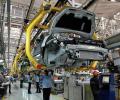
The K-shaped economic recovery in India from the pandemic slowdown shows in corporate results as well. The automobile sector, which represents big-ticket consumption, continues to do well and has increased its share in corporate revenues and profits while fast-moving consumer goods (FMCG) companies that sell low-ticket consumer goods are struggling with poor sales and earnings growth. The share of the automobile sector, including makers of auto ancillaries, in corporate net sales rose to a 10-quarter high of 10.05 per cent during July-September 2023 (Q2FY24) from 8.94 per cent a year earlier and 9.75 per cent in Q1FY24.
Investors' wealth fell by Rs 2.39 lakh crore on Monday in line with a weak trend in the global equity markets. The BSE Sensex tanked 861.25 points or 1.46 per cent to settle at 57,972.62. During the day, it tumbled 1,466.4 points or 2.49 per cent to 57,367.47.

Although large companies like Nestle, Dabur or HUL have been impacted by this slowdown in demand, it was the small, local players that have been hit harder.

Hindustan Unilever, the Indian subsidiary of the consumer goods company, has denied wrongdoing.

Unprecedented rains and floods in the northern region in the past few days have not only caused extensive damage to lives and property but have also impacted business and commercial establishments. Vegetable prices have gone through the roof in the national capital and many other parts of the country since rains started pouring earlier this month. Traders say vegetable prices would come down only after roads open and skies clear, even as water in the fields will take time to recede.

FMCG has been behaving unlike a defensive category in recent quarters.

Even as the slowdown in the information technology (IT) services sector deepens, banking, financial services and insurance (BFSI), as well as oil and gas companies, emerge as the primary drivers of corporate earnings in the country. The IT services sector's share in corporate earnings declined to a five-year low of 17.4 per cent in the second quarter (Q2) of 2023-24 (FY24), whereas banks and finance companies accounted for 46.5 per cent, and oil and gas firms contributed 16.8 per cent. At their peak, IT services firms like Tata Consultancy Services (TCS), Infosys, HCLTech, and Wipro represented just over a third of the combined net profit of all listed companies in the Business Standard sample.

The top-notch faculty at Crotonville, including Noel Tichy, Ram Charan, Vijay Govindarajan, along with GE's top leaders Jack Welch, Gary Reiner, Bill Conaty, Jeffrey Immelt and Susan Peters, together delivered sought-after programmes on leadership to generations of early-stage leaders, mid-tier and senior managers from all over the world, recounts Indrajit Gupta.

Hindustan Zinc (HZL), a subsidiary of Vedanta, announced an interim dividend of Rs 21 per share last week, resulting in an outflow of Rs 8,863 crore. The announcement has turned the spotlight on India Inc's dividend-paying policy - more so for reasons driving the generosity of firms. An analysis of BSE 500 companies by Business Standard Research Bureau shows that some of the top 20 dividend-paying companies in 2021-22 (FY22) include Vedanta, Tata Consultancy Services, HZL, Oil and Natural Gas Corporation (ONGC), Indian Oil Corporation (IndianOil), Hindustan Unilever (HUL), Reliance Industries (RIL), and Bajaj Auto, among others.

The Q1FY24 earnings season has started on a dismal note for corporate India. The early-bird companies' revenue growth has been at a 10-quarter low, while the combined earnings of non-BFSI (banking, financial services, and insurance) companies seem to have hit the ceiling. The numbers suggest corporate India is entirely dependent on BFSI companies and the IT services sector to drive growth in revenue and profit while other sectors are showing signs of stagnation.

'The impact of CEO transition is fairly even for stocks, with about half (53 per cent) of the events not producing any change in the relative performance of the stock.'

The country's largest consumer goods company Hindustan Unilever says it has been able to reduce its water use by regular metering, monitoring and controlling of utilities consumption at all its manufacturing sites

The one-minute-long ad features a young Hindu girl, dressed in a white t-shirt, who chooses to get stained in Holi colours in order to protect her young Muslim friend who has to go to the nearby mosque to pray. The advertisement ends with its classic tagline, 'Daag achche hain' (stains are good).

The biggest challenge is crude oil's sustained rally - it is nearing $80 a barrel - stoking inflationary pressures and consequent price hikes in the sector.

This is the Mukesh Ambani-led company's second entry into the dairy segment and it will directly compete with Amul and Mother Dairy.

Automobile company Tata Motors, metals and mining major Vedanta, oil marketing firm Bharat Petroleum Corporation (BPCL), private sector IndusInd Bank, and two-wheeler major Bajaj Auto have witnessed their market cap slip below the Rs 1-trillion mark this year.

It takes 6 to 8 months after the approval for a product to hit stores.

'There will always be a challenge to maintain a fine balance to ensure that the growth keeps happening and inflation is contained.'

Equity benchmark Sensex tumbled over 575 points on Thursday, tracking heavy losses in index-heavyweights HDFC twins, TCS and Reliance Industries amid a weak trend in global markets. Declining for the third straight day, the 30-share Sensex slumped 575.46 points or 0.97 per cent to settle at 59,034.95. During the day, it tanked 633.06 points or 1.06 per cent to 58,977.35. The broader Nifty-50 also declined 168.10 points or 0.94 per cent to close at 17,639.55.

FIIs have offloaded shares of Bajaj Corp, Nestle, Jyothy Laboratories and Britannia.

Consumer stocks remain the biggest laggard on the bourses. The Nify50 weighting of FMCG stocks declined to a decade low of 9.9 per cent at the end of March this year, down 150 basis points from 11.4 per cent a year ago. At their peak in March 2013, major FMCG stocks, such as Hindustan Unilever, ITC, and Asian Paints, together accounted for 15 per cent of the Nifty50. But now together with automobile stocks, the consumer goods sector accounts for only 14.7 per cent of the index, down 200 basis points in the past 12 months and 37 per cent from the record high weighting of 23.4 per cent at the end of March 2014.

Ramdev's company remains a dominant player in the naturals space, but products of rivals are also gaining popularity.

Some analysts see more upside in FMCG stocks given the performance gap between the sector and the market.

Continuing its decline for the third day on Friday, the BSE gauge plummeted 1,214.96 points or 2.20 per cent to 53,887.72 during the day. It settled at 54,333.81, a decline of 768.87 points or 1.40 per cent.

The IT major is followed by RIL (Rs 795,628.55 crore), HDFC Bank (Rs 624,362.11 crore), Hindustan Unilever (Rs 367,880.69 crore) and ITC (Rs 367,513.78 crore).

The FMCG sector is generally considered to be a safe haven during difficult times as people never stop buying soap and toothpaste. However, weak rural and semi-urban demand has been a factor since the lockdowns of 2020-21 while rising inflation has also impacted margins. While the FMCG majors have survived on the basis of price hikes and good management practices, they have seen growth slowdowns and experienced margins being squeezed as raw materials and transport costs rose. The FMCG sector witnessed positive volume growth in the fourth quarter of the 2022-23 financial year (Q4FY23) after five consecutive quarters of decline, and the rebound in demand was led by urban markets.

Top companies reported that despite most of them making staples and essential products, movement of raw material, goods and labour remained restricted, impacting sales.

The recent sell-off in IT stocks such as Infosys and Tata Consultancy Services (TCS) has resulted in a sharp decline in the IT sector weighting in the Nifty50 index. The sector's weighting in the index has slipped to a five-year low of 12.2 per cent, down from the 17.7 per cent at the end of March 2022. The top IT companies - TCS, Infosys, Wipro, HCL Technologies, and Tech Mahindra - accounted for 13.6 per cent of the index at the end of March this year.

Market experts say that of the total 600,000 villages in India, under two per cent or around 10,000 villages contribute to about half of the rural consumption in the country. Targeting these villages and ensuring that penetration is strong is key for most consumer goods companies.

The combined market valuation of six of the 10 most valued companies surged by Rs 1,56,247.35 crore last week, with Reliance Industries Ltd (RIL) emerging as the biggest gainer. While RIL, Tata Consultancy Services (TCS), HDFC Bank, ICICI Bank, HDFC and Bajaj Finance saw gains in their market capitalisation (m-cap) in the holiday-shortened week, Infosys, HUL and LIC suffered losses. Stock markets were closed on Tuesday on account of Muharram.

Reliance Industries accounted for Rs 6.3 trillion in wealth created since 1995; closest rival was Hindustan Unilever which was at Rs 4.9 trillion.

ITC's net profit grew the fastest, followed by HUL and Asian Paints.
